Zob family of Szentgyörgyvölgye (...continued)
Zob was not a common name in Hungary and even today there are very few families by that name
anywhere in the world.
Almost all the Zobs living today are the descendents of those who lived in
Szentgyörgyvölgy in the 16th and 17th centuries. If any of the above mentioned Zobs - Mihály, György
or János - was one of our ancestors, we don't know. The furthest back that we can trace our family tree
is to Zob Farkas, whose name is first mentioned in a document dated in 1610. The witnesses who signed
this document - the last will of Császár István - included Zob Farkas. Since he had to be at least 18
years old to be a witness in a legal document, he must have born before 1598 and he could have been the
son or brother of the above mentioned Mihály, György or János.
In the 17th and 18th centuries frequent hearing were held in the various counties to verify the
nobility status of landowners, presumably, because noblemen were exempt from taxes and the government
was anxious to prevent the loss of tax revenue due to false claims of nobility. At these hearings, those
who did not have documentary proof could still verify their nobility status by providing credible
witnesses at these hearings. These witness often provided genealogical information about the individuals
being investigated, such as the names of their father, grandfather, brother, uncles, etc. These testimonies
were recorded and many are still preserved in the archives at the county libraries. I was fortunate to
find a transcript of such witness testimony recorded in 1727 (see "1727 document of witness testimonies
at nobility hearings" on main page), which verified the nobility status of a Zob Mihály, who lived at
that time in the town of Szentépetúr. This transcript explains that Zob Mihály moved to Szentpéterúr
with his brother György, was the son of Péter and grandson of Farkas of Szentgyörgyvölgy, and that they
had lost their estates, which were royal donations, during the "Turkish wars".
Investigatio Nobilium 1727 - document of witness testimonies at nobility hearings
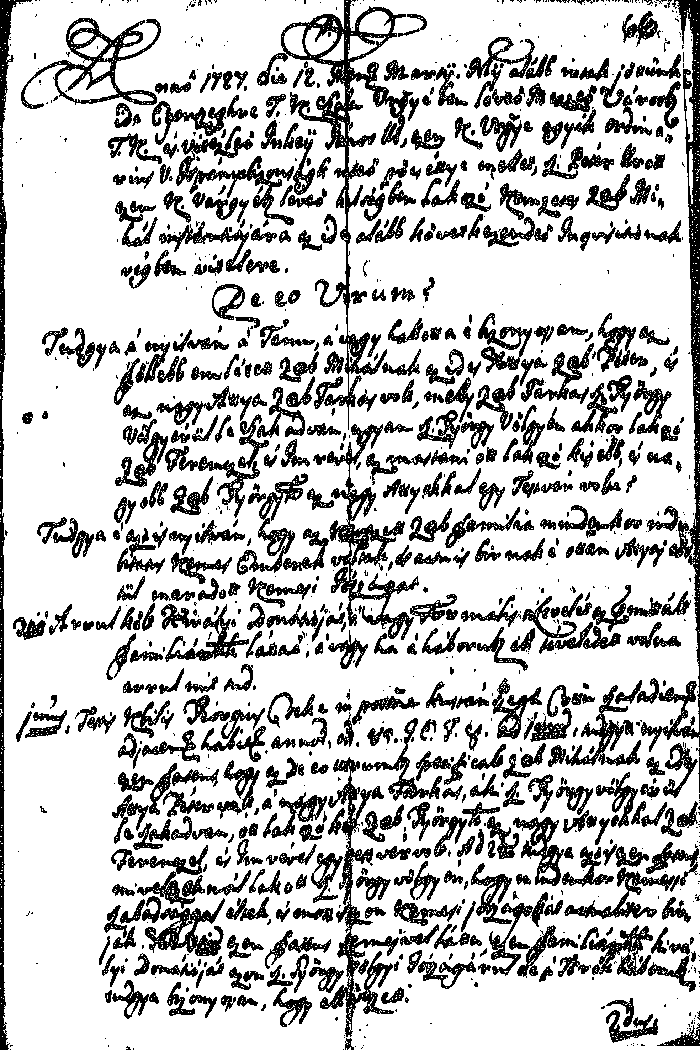
...Zob Mihálynak ez édes Attya Péter volt, a nagy attya Farkas, aki Sz. Györgyvölgyérül
leszakadván, ott lakozó két Zob Györgyto ez nagy Attyukkal Zob
Ferentzel és Imrével egy testvér volt. ... lakott Sz. Györgyvölgyén, hogy mindenkor Nemesi
Szabadsággal éltek, és most ... Nemesi jószágokat ... birják. ... szeméjvel látta, ezen
familiá..ott királyi Donátióját azon Sz. György Völgyi jószágával de a Török háboruban tudgya
bizonyosan, hogy ell veszett...
|
When or where these "royal donations" were obtained, we don't know. The Turkish occupation of Hungary
lasted from 1526 (the battle of Mohács) to 1684. Hungary was divided into three parts: the south and
central part was completely under Turkish control, Erdély (Transylvania) remained independent and the
northwest part, which included Szentgyörgyvölgy, came under Austrian control. However, the boundaries
of these areas were not defined precisely, and the Turks kept trying to expand the areas under their
control. During this time period the area around Szentgyörgyvölgy was attacked repeatedly by marauding
Turkish troops and that explains the reference to the "Turkish wars" in the transcript. However, it is
also possible that it is referring to an earlier time, before the Zobs first moved to Szentgyörgyvölgy
(see "Theories about the origin of the Zob name" on the main page.)
Another important transcript that I found was a certificate of nobility (nemesi bizonyságlevél) for
Zob Ferencz issued in Zalaegerszeg on November 14, 1829. Ferencz lived in Szentpéterúr and he was the
grandson of the above mentioned Zob Mihály. This document states that Mihály and his brother György,
who moved from Szentgyörgyvölgy to Szentpéterúr in 1728, were unquestionably (indubitato) members of
nobility, received by royal donation a property called Bodószeg, which included a "nemesi kúria" (manor
house).
![[Zob pecsét]](Szentpeterur_nobility_1742.jpg)
1742 census of nobility
in Szentpéterúr (Family names: Zops, Millei, Pállffi, Salamon, Küllős, Nagy, Patai, Kun, Pais)
|
What happened to the rest of the Zob family who stayed in Szentgyörgyvölgy after 1728? There was a
Catholic church in town and records of baptism, marriages and funerals were kept after 1720. These
church records show several marriages and baptisms involving members of the Zob clan until about 1800,
after which the Zob name does not appear anymore. Did they move to some other town or did all the male
descendents die out - we don't know. It is possible that besides Farkas' descendents there were others
who also moved to Szentpéterúr.
In the Szentpéterúr Catholic church, which started to keep written records only after 1750, many
marriages and baptisms involving members of the Zob families were performed in the next century. At
least half of these were descendants of Farkas. The Zobs intermarried with the Balogh, Salamon, Varga,
Csertán, Vida, etc. families, also residents of the Szentpéterúr area. The death of our ancestor Mihály,
son of Peter and grandson of Farkas, was recorded on Aug 28th, 1759 at age 67. The name of his wife was
not shown, but the death of his son Péter was recorded on March 1784, when he was 76 years old.
Mihály had three sons: Péter, Márton and Mihály. We are descendents of both Péter and Márton, because
Péter's great-granddaughter Eleonóra married Márton's great-grandson Antal; they were distant cousins.
Peter's son Ferencz was born in 1757 and his marriage to Erzsébet, daughter of Bereczk Ferencz of
Nemesvid, was recorded on Oct 19th 1792. (The town of Nemesvid is located about 30 km southeast of
Szentpéterúr, in Somogy county.) His signature appears on a document preserved in the Provincial
Archives of Budapest (Pest Megyei Levéltár) as "Franciscus Zob Hottus Zalad Jurassor" together with his
seal containing his coat of arms. This is the only official record we have of the family coat-of-arms
(more about this later). His title in Latin was "Comitatis Zaladiensis Jurassor"; he was a judicial
representative of Zala megye.
Ferencz and Erzsébet had only one son, János, who was baptized in Szentpéterúr on June 10th, 1793.
He became a county government employee (megyei aljegyző) and I presume he also had a degree in law,
like his father. He married Bene Mária, who was 18 years old, on Dec 8, 1822 in Kéty, Tolna megye, where Mária's
father, sümegi Bene Károly was a landowner, and an attorney working for various large landowners
(including the Dőry family) in Tolna. By coincidence, Károly's sister Borbála was married to Eperjessy
Gábor, Mana's (Sanveber Magdolna's) grandfather's grandfather. At the time of the wedding in 1822, 44
years old Borbála was already a widow. We may assume that she attended her niece's wedding.
János and Mária had four children born, Maria, Theresia, Antonia and Eleonóra, all daughters. Today
our name would not be Zob, if Eleonóra did not merry a cousin, Zob Antal. They married after the 1848
national uprising, in which Antal served as a lieutenant in the 47th battalion (zászlóalj) of the
Hungarian army. He was later promoted to the rank of captain.
![[Zob pecsét]](Zob_pecset.jpg)
Zob coat-of-arms on a seal used by
Zob Ferenc and Zob József in 1816
|
Antal, like Eleonóra, was also a descendent of Zob Mihály, whose other son, Márton was the
great-grandfather of Antal. Márton and his wife Vida Judit had a son József, born in 1747. He was 21
years old when he married Szladovics Borbála, also 21, the daughter of a noble family in a nearby town.
They had seven children who all became orphans; Borbála died in 1790, when she was 42 years old and
József followed three years later in 1793. By the time their eldest daughter Juliana turned 17 both of
her parents were dead. Our ancestor József was only 12 years old, still a minor. Although the seven
children were to inherit the parent's property, it would be held in trust for them until the youngest
child reached the age of maturity, and they could not receive any income from it until then. I guess
the law did not care if they were going to starve to death in the meantime, and they had no choice but
to wait until that time arrives.
It appears from a letter that József wrote in 1829, six years after his father died, that the seven
children experienced great hardship during this period. This letter is an appeal to the authorities to
allow him to receive some minimal income so that he could continue his education. He says that he had
lived in poverty and at times he had to resort to begging to survive. He alludes to receiving some
support from count Festetics György, who must have taken pity on him, being the son of a nobleman.
Somehow he managed to complete his education through highschool (gimnázium) in Keszthely and graduated
with excellent grades ("35 diáktársamból négy közül kiérdemeltem a kiváló helyet"). He applied for a
scholarship while he attended university.
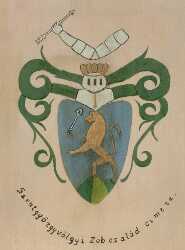 Zob family coat-of-arms drawn by Zob Péter
|
It appears that József did receive a scholarship, because he became a practicing lawyer in Sümeg
(the small city where I was born). He left Szentpéterúr and settled in Nagygörbő, a small town near
Sümeg. Here he married 29-year old Miskey Zsuzsanna in 1824, when he was 43 years old. Zsuzsanna's
grandmother was Hevenyessy Erzsébet, whose family were landowners in Nagygörbő and her father István
and uncle Antal occupied influential positions (táblabíró) in the county judiciary. Thus Zob Antal
succeeded in overcoming the handicaps which he started out with as an orphan, and even through his
marriage he was able to advance his family's fortune. Whether his six siblings succeeded equally well
in life? We don't know.
József's and Zsuzsanna's son Antal, who married Eleonóra, was born in Nagygörbő on May 29th in 1825.
As I mentioned above, Antal was a captain in the Hungarian Army during the 1848 uprising.
Unfortunately, after more than a year of fighting against the Austrian and Russian armies, the uprising
was defeated. Many of the officers in the Hungarian army were captured and sent to prison. The thirteen
top generals were executed. It was a difficult period for Hungarians who opposed the Austrian occupation,
and many families suffered greatly. Antal went into hiding, but evetually he captured and imprisoned in
the notorious Austrian fort at Kufstein. Eleonóra was left alone to look after the land and to raise
their six children. The years spent in Kufstein must have been horrible times for the 23 years-old Antal
and his health suffered a great deal. He died young, at age 38, when our grandfather Gyula was only five
years old. They must have lived interesting lives; I wish they had left behind some letters or diaries,
so we would know more about them.
Antal and Eleonóra had six children: Antonia, Mária, Lajos, Gyula, Julianna and Gizella. Of the four
girls we know only that Antonia married Csecsinovics Károly and Julianna married Kisfaludy István. (See
Kisfaludy family under "family index": the Kisfaludy family traces its ancestry all the way back to
Előd, one of the seven chiefs of the original tribes, who elevated Árpád to be their leader and the
leader of the newly formed Magyar nation, as it was embarking on the conquest of the Carpathian Basin,
the future homeland of the Kingdom of Hungary.)
![[Zob Gyula]](./Pictures/Zob_Gyula_family.jpg)
This is a copy of
a daguerreotype photo in Zob Viola's possession. Written in handwriting on the back of the original: "Déd nagyapa
Zob Gyula 1879" - "Great grandfather Zob Gyula 1879"
|
Gyula was my grandfather, whom unfortunately I have never met; he would have been 80 years old when
I was born. Eleonóra made great sacrifices to provide a good education to her children. Gyula was able to
attend the Engineering University in Budapest (Müegyetem), where he received a degree in civil
engineering. Eleonóra used to send food supplies to Gyula in Budapest by horse drawn carriage, which
back then was quite an accomplishment. (It would have taken at least three days to ride from Nagygörbő
to Budapest.) By the time the children had grown up, Eleonóra sold off most of her property in Nagygörbő,
and she moved in with her daughter Juliana and son-in-law Kisfaludy István in Sümeg, where she spent
the rest of her life until her death in 1920.
After graduating from University, Gyula received a job with the Hungarian Railroad. His first
assignment was as station chief in a small town called Hidas, in Baranya county. Most of the people of this
town were German-speaking immigrants, who settled here in the late 18th century. Gyula fell in love and
married Erzsébet, the daughter of Laub Konrád and Reinhard Katalin. According to Mana, she was the
daughter of a rich Austrian wine-merchant, but in the birth records he is referred to as a farmer.
She never learned to speak Hungarian fluently and Mana mentioned that at times she had difficulty
communicating with her.
From Hidas, Gyula and Erzsébet moved to Zágráb, where he was promoted to station chief. This was a
major stop along the railway route from Budapest to Fiume, on the Adriatic Sea, which was the only
seaport of Austria-Hungary. Today Zagreb is Croatia's capital. Gyula succeeded in purchasing a beautiful
estate in Rakovec (Vrbovec) near Zágráb, which was forfeited by the previous owners. It included the
ruins of an ancient castle, which belonged to the famous Zrinyi family in the 16th century (see Zrinyi
in the name-index).
Gyula and Erzsébet had four children, but Gyula died early and, if I remember correctly, Papa had no
memory of him. The eldest son's name was also Gyula. His father died while he was still a teenager and
he had to share the burden of supporting a family in a strange land with his mother. Although Croatia
was part of the Kingdom of Hungary, the Magyars were a minority among the Croats, many of whom did not
speak Hungarian and were antagonistic towards the Magyars. I vaguely recall stories of roving bands of
gypsies attacking their house in Rakovec, while Erzsébet and Gyula jr. were firing shots from various
windows, trying to create the impression that there were more than just two defenders in the house.
Apparently this trick worked and the gypsies retreated.
Unfortunately Gyula's education was interrupted by a tragic event. I don't remember the exact time
and the circumstances, I only know that Gyula was involved in a duel, and his opponent was injured,
perhaps fatally. That would have been perfectly alright a hundred years earlier, but by the 19th
century duels were not considered to be a legal way of resolving issues of honor. He had to go into
hiding and left the country. Then he immigrated to America, where he became an adventurer. He had
traveled to the Yucatan in Mexico and later he took part in the Yukon gold rush. Once he returned to
Hungary to visit his mother and siblings. He spent time in Budapest, where he spent a lot of money in
gambling casinos. Then he returned to the US and was never heard of again. The family made several
inquiries after WW I, but there was no trace of him. However, one piece of suspicious information did turned up:
a companion of Gyula, whose last name was Dolgos, became a wealthy jeweler in Chicago. But that's where
the trail ends.
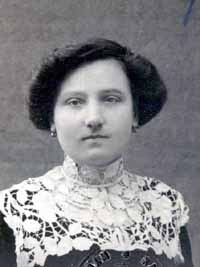
Zob Erzsébet, Péter's sister, 1912
|
After Gyula's disappearance Erzsébet carried on the support of the family by herself. She managed
to have the remaining three children complete their education. Her second son Mihály became a lawyer,
and her daughter Erzsébet became a teacher. Her youngest child was Péter, my father. He was born on June
28th in 1897, and was only 17 years old when the First World War erupted. It was a terrible war for
Hungary; we got dragged into it only because our foreign policy was controlled by Austria. Péter wanted
to be an engineer, like his father, but because of the war he gave that up. He joined the army and
enrolled in the Military Academy (Ludovika), where he graduated with honors in 1917 and entered the
war as a lieutenant.
The war ended in 1919 in total disaster for Hungary. While the defeated army was scattered outside
the country (some of them in Italy where Péter ended up, some on the Russian front), an uprising took
hold of Budapest and spread like wildfire into the country. It was led by a group of revolutionaries
who were educated and trained during the Bolshevik revolution in Russia.
They terrorized the population everywhere they went. Mana still remembered in her old age how one of
their leaders, Tibor Szamuelly, traveled around the country in an armored train (like in the movie Dr.
Zsivago), and each town where he stopped his henchmen lined up the population, and shot every tenth
person in the lineup, men, women and children alike. Eventually, as the retreating troops returned to
Hungary from abroad, the army officers organized an effective force to defeat and destroy the communist
terrorists.
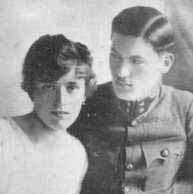
Zob Péter and Sanveber Magdolna (c. 1920)
|
An excellent book about the 1919 bolshevik revolution in Hungary is "An outlaw's diary: Revolution",
written by Tormay Cecilia, who was the niece of Tormay Mária, Eperjessy Sándor's first wife. It has
been translated into English (published by The Christian Book Club of America, Hawthorne, California).
She describes her personal experiences during the revolution in Budapest and her desperate flight from
the communists as she went into hiding in a small town in northern Hungary.
Péter's first priority after he returned from the Italian front was to visit his mother in Rakovec.
The situation quickly deteriorated there too, but for a different reason. The Croats were seeking
independence from Austria-Hungary, and the hostility towards the Hungarian minority was increasing.
Erzsébet received threats on her life and attempts were made to confiscate her property. Péter had to
return to Hungary to report to the military authorities and Erzsébet decided to flee her home and
returned to Hungary. Along the way she made a dangerous border crossing by taking a rowboat across the
river Mura. How much of her belongings she was able to take with her? Did she get any help from
anybody, relatives or friends? Did she travel by horse drawn carriage, or was she able to ride the
train? Where did she go in Hungary? Back to Hidas where her parents lived, if they were still alive?
These are questions I should have asked when my parents were still alive. Now the answer will never
be known.