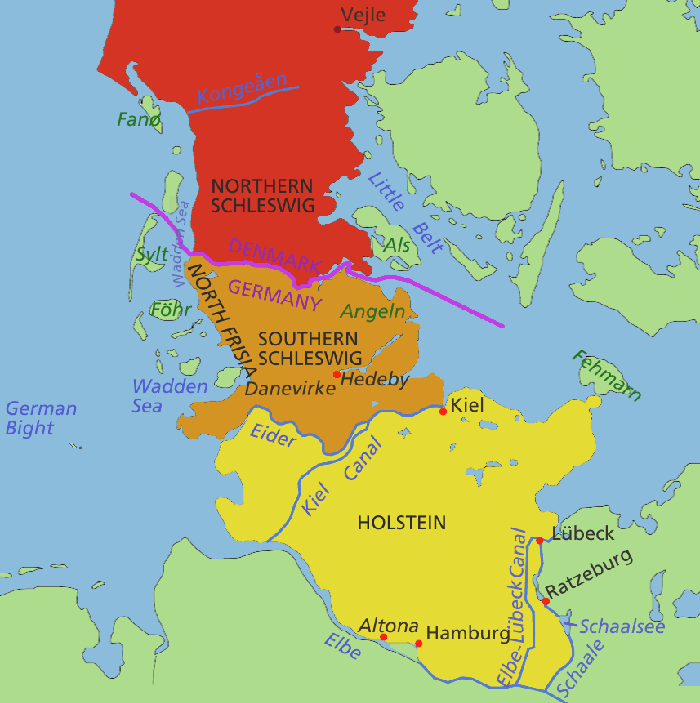
Map of northern Germany and southern Denmark
Adolf II succeeded his father under the regency of his mother, Hildewa. After the death of the Emperor Lothair II in 1137, Conrad III, the new king, granted the Duchy of Saxony to Albert the Bear. Adolf II was consequently deprived of Holstein because he was a Welf supporter and refused to recognise Albert as duke. He only received it back in 1142 when Conrad and Henry the Lion were reconciled.
In 1143, Henry and Adolf divided the rule of the conquered Slavic lands to their east. Adolf received Wagria with its chief city, the castle of Sigberg, built by Lothair, and Henry received Polabia with Ratzeburg as its capital. Sigberg became Adolf's chief fortress and most regular seat. Adolf promoted Christianity in his new lands, especially through the missionary work of Vicelinus. Adolf, encouraged by Lothair, promoted German colonisation of his Slavic territories, especially with colonists from not only his own lands but also from Westphalia, Flanders, Holland, Utrecht, and Frisia.
Adolf supported Sweyn III of Denmark against the claimant Canute V in a dispute over the Danish throne. Canute, with the help of Etheler von Dithmarschen, attacked Holstein and burned Oldenburg, devastating the German north coast.
In 1159, Adolf accompanied the Emperor Frederick I into Italy and in 1164 he aided Henry the Lion against the Obotrites, dying in the Battle of Verchen. He was buried in Minden. He was succeeded by his son, Adolf III, under the regency of his widow, Mechtild of Schwarzburg.
Adolf III was the ruler of the Counties of Schauenburg and Holstein. He is particularly remembered for his establishment of a new settlement for traders on the banks of the Alster near the Neue Burg in Hamburg. He accompanied Henry the Lion on his expedition against Philipp von Heinsberg, Archbishop of Cologne, fought at the Battle of Halerfeld at the side of Count Bernhard I of Ratzeburg, when he received from Henry the Lion the decisive rights in the region of the Middle Weser, which formed the basis of the County of Schauenburg.
In 1180 Adolf defected from Henry, who thereupon drove him from Holstein. Adolf attached himself to Frederick Barbarossa (Emperor Frederick I), with whose help he regained his lordship in 1181 after the fall of Henry. In 1188 however Frederick turned down Adolf's claim to the town of Lübeck. Adolf accompanied him on the Third Crusade. In August 1190 he reached Tyre, where he left the crusading army and returned to Holstein to defend his lands against Henry the Lion, who had in the meantime returned from exile.
The reign of Adolf III coincided with Denmark's attempts at expansion under Kings Canute VI and his brother and successor Valdemar II. After Adolf lost the Battle of Stellau in 1201 and was later taken prisoner in Hamburg by Valdemar, this expansion was successful for some decades. In captivity Adolf was forced to renounce his title to the County of Holstein in 1203 in order to gain his freedom, and on his release retired to the County of Schauenburg. The reconquest of Holstein was left for his son and heir, Adolf IV of Holstein.
Count Adolf III married firstly, in 1182, Adelheid von Assel (d. 25 December 1185) and secondly Adelheid von Querfurt.
Adolf IV, Count of Schauenburg and of Holstein, won several victories against the Danes. In 1225 he won the Battle of Mölln against Albert II, Count of Weimar-Orlamünde. On 22 July 1227 with his coalition army Adolf was victorious in the Battle of Bornhöved against a Danish army under the command of King Valdemar II of Denmark and thus regained Holstein. In 1235 he founded Kiel and in 1238 Itzehoe. In 1238 he took part in a crusade in Livonia.
In fulfilment of an oath taken during the heat of the Battle of Bornhöved, Adolf withdrew in 1238 to a Franciscan friary and in 1244 was ordained a priest in Rome (his two under-age sons passed into the guardianship of his son-in-law Duke Abel of Schleswig). Also in 1244 he founded Neustadt in Holstein. He died in 1261 in the Franciscan friary in Kiel, which he himself had founded, whereupon Holstein was divided between his sons John (of Holstein-Kiel) and Gerhard (of Holstein-Itzehoe).
Er war der zweite Sohn von Adolf IV. von Schauenburg und Holstein und Hedwig von der Lippe. Als sein Vater sich 1238 in ein Kloster zurückzog, regierte er gemeinsam mit seinem älteren Bruder Johann, anfangs unter der Vormundschaft von deren Onkel Herzog Abel von Schleswig. Als Adolf IV. 1261 starb, teilten Johann und Gerhard Holstein in die Grafschaften Holstein-Kiel und Holstein-Itzehoe, wobei Gerhard den Teil mit Stormarn, Plön und Schauenburg übernahm und in Itzehoe residierte und Johann den Teil mit Kiel, Wagrien, Ostholstein. Er baute dort die Herrschaft mit Rodungsbesiedlung planvoll aus, sodass mehrere Orte entstanden. 1255 schlossen die Brüder ein Handelsabkommen mit Lübeck. Gerhard bekam Rendsburg vom Bruder Johann, welches er von Dänemark zurückgewann und trat dafür Segeberg ab. Er half den Neffen in Schleswig gegen Dänemark und sicherte so das Gebiet Eckernförde. Er siegte 1262 in der Schlacht auf der Lohheide. Als sein Bruder 1263 starb, wurde er als Vormund der Söhne von Johann Regent von Kiel und Segeberg. Er stritt viel mit den Erzbischöfen von Bremen, mit Lübeck und dem Landadel und baute die Verwaltung aus.
Sometimes called “Gerhard the Great”. In Denmark also known as “Count Gert” or “den kullede greve” (Eng.: The bald Count). A German prince who was the ruler of most part of Denmark during the Interregnum 1332–1340. He was the son Henry I of Schauenburg and Holstein-Rendsburg and Heilwig von Bronckhorst. Gerhard inherited his part of the county of Holstein as a boy but already as a young man he enlarged his heritage by manoeuvring out his relatives and his conquest of other parts of Holstein made him a powerful local prince.
|
1325 Gerhard began his career in the North by taking over the guardianship for his minor nephew Duke Valdemar of Schleswig. This position made him a possible ally of the dissatisfied Danish magnates and 1326 he dethroned King Christopher II. From then until his death he was a main factor of Danish politics. He placed his nephew on the Danish throne, was made the regent of Denmark and at the same time he secured the separation of Schleswig from Denmark by the so-called Constitutio Valdemariana which made the ground of the long-standing German influence on South Jutland. In 1330 Gerhard replaced Valdemar by Christopher II as the puppet king. After the death of Christopher in 1332 he quite simply took over the rule himself.
From 1332 to 1340 Count Gerhard was the real ruler of most of the dissolved country being the lord of both Jutland and Funen. He did not try to make himself a king or a regent but seems to have been ruling as a military dictator and mortgagee exploiting his possessions as much as possible. However, his position was unsafe because he himself had new creditors who had financed his armies and therefore had a hold on him. The result was a growing opposition against the foreign rule also within the Danish gentry that had earlier supported him. Peasant rebellions and lawlessness at sea created a growing chaos and Gerhard was put under pressure from the German neighbouring states now supporting Christopher’s son Valdemar (afterwards Valdemar IV) who acted as the official pretender. Gerhard seems to have prepared a political climb-down in return for his outstanding debts, but before a solution was reached he made a new campaign against rebels in North Jutland in the spring of 1340. Here he was slain in Randers by the Danish squire Niels Ebbesen who entered his bedroom together with some of his men. His death meant the end of the Holstein rule and his two sons gave up their position in return of a satisfying economic compromise that brought Valdemar on the throne
Because of his political role Gerhard has been highly variously judged. In Denmark he is traditionally regarded a scoundrel and a “German tyrant” and his murder has been viewed as one of the highlights of Danish history, having inspired Danish poets and authors as late as during the German occupation of Denmark 1940–1945. In the Ditmarshes (Dithmarschen) in which he ravaged he also seems to be unfavourable viewed. In Holstein however he has been something of a national war hero who was almost worshipped as a saint. From contemporary sources he appears an energetic, brutal and deeply religious warrior.
During his marriage to a niece of Eric VI and Christopher he in fact became the ancestor of the present Danish Royal family.