Dirck Volckertszen De Noorman
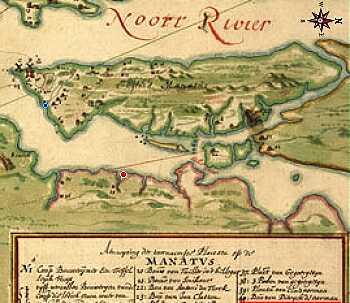
"Manhattan Lying on the North River," as the
Hudson River was then called, was mapped in 1639, probably by surveyor Andries Hudde. The European
population was roughly 500. The main concentration of Nieuw Amsterdam's settlement was at the southern
tip of Manhattan Island, indicated here at the left end of the island by two windmills and the outline
of the fort. Dirck's actual residence in 1639, indicated by a blue dot, was near the intersection of
Pearl Street and Wall Street. He commuted across the East River to tend his farm, not moving his family
there until 1645. He continued to have interests on both sides of the river. Indian wars in 1643 and
1655 forced Dirck and other Long Island settlers to retreat to Manhattan.
|
The New Netherlands colony's new director, Peter Mimuit, was anxious to demonstrate that their new
colony had the resources and potential for a ship-building industry. By 1628 he imported a group of
Scandinavian ship carpenters. This would place Dirck's arrival between 1626 and 1628, but it is also
possible that he was already
there in 1625, when the West India Company started the construction of houses in the new colony. (In 1624,
the first year of the New Netherlands settlement, most of the colonists lived "underground" in log-lined,
sod-roofed dugouts.) This scenario might have seen Dirck building the Vigne's house on the East River....
and meeting a Christine Vigne who was in her early teens in that year. And as you'll see further down the
page, Dirck was a house builder.
Dirck married Christine Vigne in 1630/31, daughter of Guillaume Vigne and Adrienne Cuvelier The Vignes
were among the first 30 French Walloon families whom the Dutch West India Company imported to establish the
New Netherlands colony in 1624. [By the way, Peter Miniutt was not Dutch...he was a French Walloon like the
Vignes.] Dirck and Christine lived on her parents' farm, at the south end of Broadway, until 1638.
Christine's father died in 1632, and Dirck and his mother-in-law were named executors of the will, as
recorded below:
"We, the underwritten, William Wyman, blacksmith and Jan Thomaisen Groen, as good men do attest and
certify that before us appeared Dirck Volckerson, the Norman and Ariantje Cevelyn, his wife's mother in
order to agree with her children by her lawful husband, deceased; she gives to Maria Vienje and Christine
Vienje, both married persons each the sum of 200 guilders as their share of their father's estate. To
Rachel Vienje and Jan Vienje both minor children, each the sum of 33 guilders, under the condition that
with her future husband, Jan Jansen Damen, she shall be held to keep the said two children in good support,
until the come of age, and that she shall be obliged to clothe and feed them and make them go to school as
good parents are bound to do."
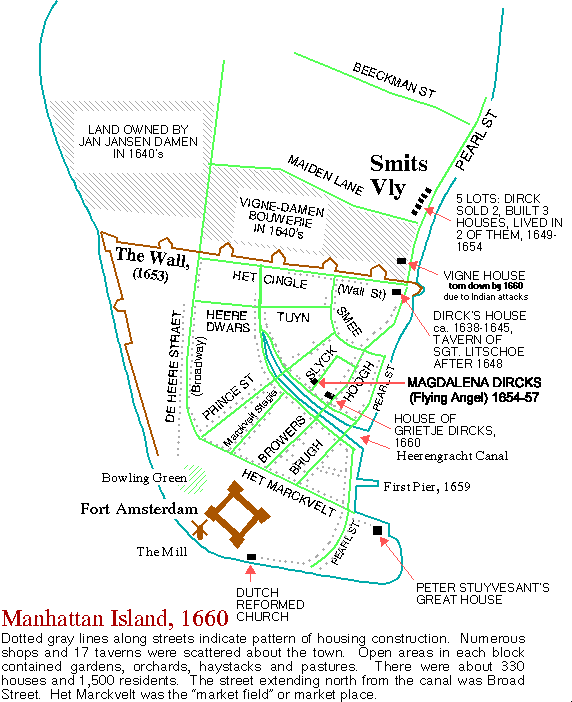
Between 1638 and 1645 the Volckertszens lived in a large house - it's location today would be at 125
Pearl Street, just below Wall Street - on a quarter acre lot with a garden and apple trees. Dirck began
farming in earnest in 1638, when he leased a bouwery (farm) and stock from the colony's Governor. This
farm was near his brother-in-law, Cornelis Van Tienhoven's "plantation" at Smits Vly (Smith's Flat),
northeast of Wall Street. On August 4, 1649, Van Tienhoven sold property on the 250 block of Pearl Street
to Dirck and their other brother-in-law, Abraham Ver Planck. The lots were about a half-acre each,
extending along Pearl Street on the East River to some high ground at the rear.
Dirck subdivided his lot into smaller properties, and during the next five years sold the lots with or
without a house. The deeds are recorded. Hage Bruynsen the Swede bought a lot from him in November 1653
and built his own house. Then in 1649 Dirck built himself a house at 259 Pearl Street. In 1651 he sold it
to a Swedish sea captain from Goteborg - after building himself another new house. Dirck and Abraham
later owned other lots on Manhattan through their wives' inheritance, which was substantial: their
mother-in-law Adrienne Cuvelier and her husband Jan Jansen Damen owned Manhattan from Pine Street north
to Maiden Lane, and from the East River to the Hudson River, encompassing most of the Wall Street
financial district and the World Trade Center.
 |
Another significant development occurred in 1638 - the Indians agreed to allow Dutch settlement in
Brooklyn. Dirck was one of the first to take advantage of the newly-available lands, receiving a grant
to buy 400-500 acres of land from the Indians. It had a mile-long frontage on the East River and had
nearly the same frontage on the two tidal streams that bounded his land on the south and north sides,
Norman Kill and Mespath Kill. (The Dutch called streams or creeks "kills"). The inlet where the creek
emptied into the East River, immediately south of Dirck's house, still exists today. The northwest point
on his East River frontage was known by several names, including Noorman's Point and Woud Hoek (Woodland
Point). Years later it was planted with green wheat fields and gained its current name of Greenpoint.
Dirck was one of the few Brooklyn property owners who actually improved their properties in the early
years. It is said that the Indians came back to him each year, asking for more money, because the land
had increased in value. His improvements suffered some setbacks in the Indian uprisings of 1643 and 1655,
when fields were destroyed and homes and barns were burned. Indians killed two of his sons-in-law, Jan
Schutt in 1652 and Cornelis Hendricksen Van Dort in 1655, and tortured a third, Herman Hendricksen
Rosenkranz, for eight days in 1659.
In January 1656 Dirck Volckertszen was sued by Jan De Perie, a barrel-maker, who claimed Dirck stabbed
him and "chased him from the Strand to the Clapboards." The suit demanded payment for surgeon's fees and
loss of time. The quarrel began during a dice game on December 18, 1655. De Perie was trying to cheat and
Dirck caught him at it. The argument turned into a fistfight and ended with both drawing their knives.
Dirck was stabbed in the shoulder, De Perie in the belly. Dirck filed a countersuit to call several
witnesses. De Perie's servant Jan Fredericksen testified Dirck struck first, and that De Perie chased
Dirck through the streets. Maria Peeck, a tavern-keeper's wife, told of hearing De Perie conspire with
his servant before the game, saying "There's Dirck the Noorman, who has a box of seawan (Indian shell
money) in his sack, and he should play or the Devil should take him." The case dragged on until June 1658,
when Dirck agreed to pay a fine for wounding De Perie. By the time the trial ended, Dirck held the post
of city carpenter and his brother-in law Jan Vignr was on the City Council...so his fine may not have
been very high.
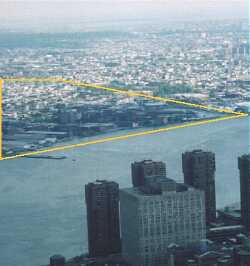
Part of Dirck Volckertszen's farm in 1638 is
shown outlined here, as seen from Empire State Building
|
Dirck was listed third on the charter of incorporation for the town of Boswyck (Bushwick) which was
founded with 22 families (mostly French Walloons) in 1655. The town was on the south border of his
property. In 1662 he and some other landowners petitioned the authorities to have a road made to their
properties. Dirck gave some land to the town, probably for the right of way and in payment for the road.
In 1663 he served some role with the town's militia, and in 1664 he was Superintendent of Fencing (the
wooden palisades surrounding the village for protection against Indian attacks).
Dirck and all of his family settled down around Boswyck. One historian states that "Dirck naturally
contributed in the layout of the village, and in the construction of the buildings, the docks at the
waterways, the roads and highly important palisade." He also notes "his lore in Indian warfare" and "the
stimulation of his belligerent personality in creating courage and initiative in those fellow settlers
who had but recently arrived from European countries...He must be considered to have been one of the
three outstanding personalities in the history of the town of Boswyck. He became its patriarch. He was
its oldest constituent." Dirck paid taxes to the town of Boswyck in 1675, and to New York in 1677. He
died about 1678 or 1680, and was probably buried on his farm. His wife Christine had preceded him in
death...there is no record of her after 1663. In the 1850's the stone house was demolished, and a knoll
believed to contain the family plots was leveled, to provide sand for construction in Manhattan.
Dirck Volckertszen De Noorman and Christina Vigne were the parents of six daughters and two sons of:
Grietje, Magdalena, Sarah, Rachel, Volkert, Jacob, Ariantje, and Jannetje.
The Dutch and Norwegian cultures used a "patronymic" naming system in which the father's first name
became the children's last name, so there was no such thing as a "family name" that passed from one
generation to the next. Under this system, the surname of Dirck's children was Dircks (sometimes spelled
Dirckse or Dirckx). In the following generation, the children of his son Volkert Dircks had surnames
based on his first name, Volkert.
The English seized New Amsterdam by military force in 1664 and renamed it New York, marking the end
of both Dutch rule and the patronymic system. The patronyms then in use by the former Dutch colonists
became permanent family names, and over time were 'translated' into English surnames. In our case, a
permanent last name was established, based on the root name of Volkert. Over the next 75 to 100 years,
the family name was spelled Volkerts, Volkertse, Folkerts, Folkertse, Volkertson and Folkertson. By the
time of the American Revolution it was almost universally spelled Fulkerson. Many other variations of
the Fulkerson surname can be found in American records of the 18th and 19th centuries: Falkerson,
Faulkerson, Folkerson, Fulkersin, etc. These variations were generally either (1) a matter of preference,
or (2) frontier spellings concocted by guessing at the sound of the name.
Source: American Fulkerson Homepage (http://www.fulkerson.org/)